Miyawaki well
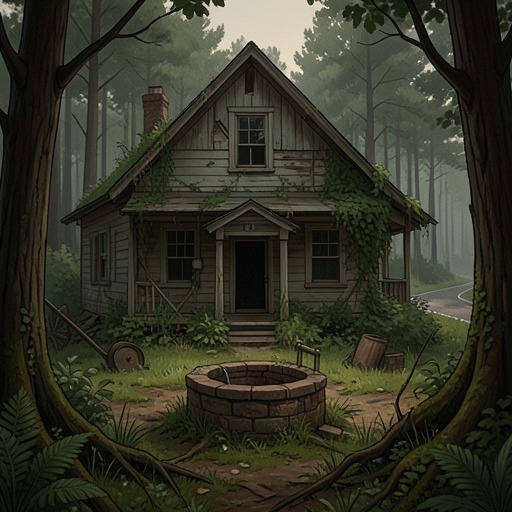
The Wind-Up Bird ChronicleThe Miyawaki well is a deep, dry well in the yard of the vacant Miyawaki house and the setting of Toru Okada’s prolonged confinement. When May Kasahara seals its mouth, the well’s darkness becomes more than a chosen retreat: it is a concrete enclosure in which hunger, exhaustion, and the fear of suffocation make survival uncertain. Its eventual disappearance beneath the cleared property leaves a stark contrast between the ordeal Toru remembers and the ground on which no trace of the well remains.
Structure and Setting
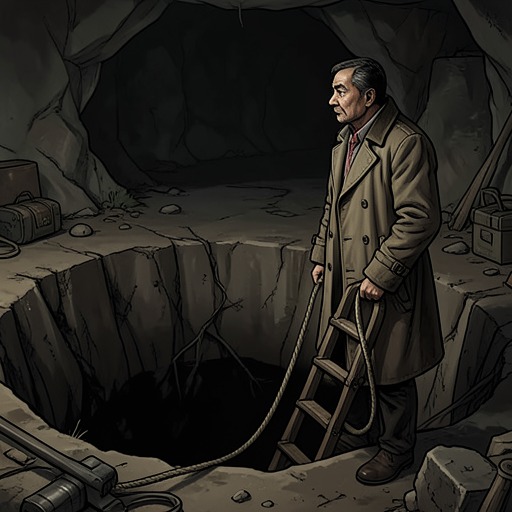
The well is a deep, narrow concrete tube beneath the yard of the vacant Miyawaki house. In Toru’s confinement, its depth and narrowness matter as much as its darkness: once the opening is sealed, he cannot climb out or readily know what is happening above him. The well’s mouth is the fragile connection between the enclosed space below and the world outside it.
That connection is made visible when the cover is partly opened. Looking upward, Toru sees a beautiful, starry sky shaped like a half-moon; the sky does not remove the physical danger, but it marks the return of an opening through which a voice and a possible rescue can reach him. Above and below are not simply different locations: the covered mouth can cut him off from the world, while its reopening gives him a line toward it.
Sealing and Confinement
After May Kasahara seals the well’s mouth, Toru waits for her to return. His body is already suffering: hunger pains come and go, his muscles and joints hurt from remaining in an awkward position, and even ten knee bends leave him dizzy. He tries to breathe deeply and clear his mind, but his weakness makes speaking difficult. The bodily details establish confinement not as an abstract ordeal but as a gradual loss of strength and the ability to think.
The wait stretches through the morning and past noon, without May appearing. Toru’s concentration breaks apart; thoughts vanish almost as soon as they arise, and each new wave of darkness seems to take away more of his capacity to focus. Fragmentary memories then arrive in vivid detail, moving among houses he had lived in, their windows and furniture, and the teachers he had known. The well’s isolation does not produce a single orderly recollection: it opens onto a scattered inventory of a life.
Fear intensifies when Toru considers that no one may know he is still alive. He imagines that May could have been injured, leaving him entirely undiscovered, and then revises the thought: perhaps she is deliberately making him wait to frighten him. He cannot establish which possibility is true. What he can feel is the abandonment itself, and the narrowing prospect that hunger may weaken him until even a lowered ladder would be useless.
The sealed opening also turns air into a threat. After more than two days at the bottom of the narrow concrete well, Toru worries that its top has prevented meaningful circulation. He cannot tell whether the oppressive heaviness is real or imagined, but deliberate attempts to breathe only make the sensation worse. His fear shifts from starvation, which might take time, to asphyxiation as an imminent possibility. The well thus makes uncertainty bodily: Toru cannot measure the air, escape the space, or determine how quickly danger might overtake him.
Opening and Return
A voice calling from above reaches Toru while he is caught between sleep and wakefulness. It sounds like Creta Kano, though darkness prevents him from seeing who is there, and exhaustion leaves him with little strength in his fingers. When he looks upward, the well cover is half open and the starry sky is visible. He answers and manages to stand. The opening changes the well’s immediate condition from sealed enclosure to a place connected again with the surface, even as Toru remains weak and disoriented.
Later, after a late-night call with Malta Kano, Toru suddenly remembers that the rope ladder is still hanging in the well and worries that someone might find it. He also recalls that Creta Kano disappeared after he last saw her at the well. Near three in the morning, he crosses the garden wall, follows the alley to the vacant house, and finds the ladder still anchored at the base of a tree, descending through the half-open cover. He calls Creta’s name and shines his flashlight down, but its beam cannot reach the bottom; a faint moaning sound is the only response he hears. The well remains bound to unresolved danger and absence, not merely to the earlier episode of his own confinement.
Demolition and Meaning
In winter, Toru returns to the site of the vacant Miyawaki house. The house has been completely demolished and the yard enclosed by a high plank fence. Looking through its gaps, he sees no house, paving stones, well, trees, television antenna, or bird sculpture. The site is a flat expanse of cold-looking black earth, compacted by bulldozer treads and broken only by scattered clumps of weeds. The well that once held him is no longer visible in the landscape.
Toru leans against the fence and looks toward May Kasahara’s second-floor room, but she is no longer there either. The vanished well and May’s absence meet in the same winter scene: the space that once contained Toru and the neighbor who watched over or withheld access to it have both receded from view. He can hardly believe there had been a deep well in that yard, much less that he had climbed down into it. Its disappearance does not cancel the experience; instead, the blank earth sharpens the distance between a remembered, life-threatening enclosure and the altered ground that has taken its place.
Narrative Significance
The well’s meaning changes through access. Its depth first makes descent possible; May’s sealed cover turns that chosen movement downward into involuntary confinement; the partially opened cover restores contact with the sky; and demolition ultimately erases the well as a physical feature. Each change alters what the space permits Toru to do, from entering it to enduring it, looking out of it, and finally remembering it from outside.
The well also gives physical form to the difference between darkness as a space of inwardness and darkness as danger. At the bottom, Toru’s memories become unusually vivid even while his ability to concentrate collapses, and the absence of air and food threatens to make that inward retreat fatal. Later, the site is reduced to earth that appears empty of the features Toru remembers. The well therefore remains significant not because the novel leaves it standing, but because its disappearance makes the remembered descent harder to reconcile with the ordinary ground that has replaced it.